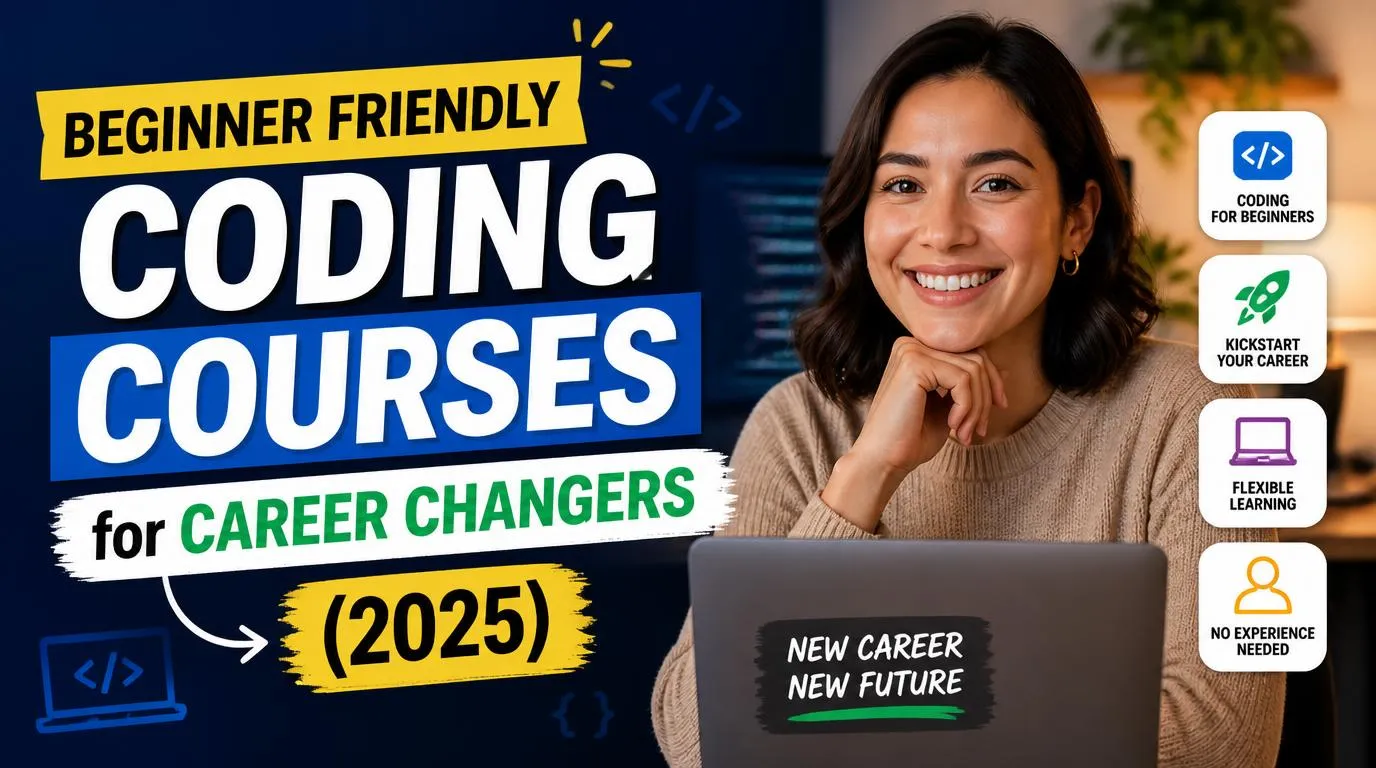
When I started searching for beginner friendly coding courses for career changers starting fresh, I was a burned-out restaurant manager with exactly zero tech skills. I didn’t know the difference between HTML and CSS. I just knew I wanted a paycheck that didn’t require me to work every weekend and holiday. If that feeling sounds familiar, you’re in the right spot. I spent months testing platforms, wasting money on some, and finding gold in others. Here’s what actually works.
1. freeCodeCamp: The Best Free Starting Point
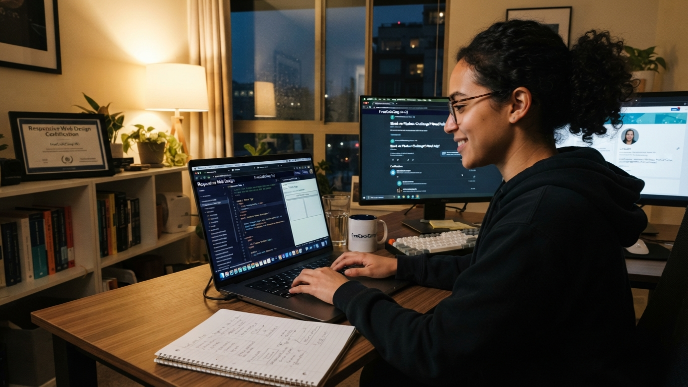
freeCodeCamp is exactly what it sounds like, and it’s shockingly good for a platform that costs nothing. The entire curriculum is project-based, which means you build actual websites and apps instead of just watching someone else do it. I started here before spending a dime anywhere else.
What makes it stand out is the certification path. You work through Responsive Web Design, JavaScript Algorithms, and more, earning certificates along the way. Those certificates gave me something concrete to put on my LinkedIn when I had zero tech credentials. The community forum is active too, so you won’t feel stranded when you get stuck on a challenge at 11pm.
2. Codecademy Pro: Structured Learning Without the Overwhelm
Codecademy was the first platform where coding actually clicked for me. The interactive editor lets you write code directly in the browser, and it checks your work line by line. You never have to set up complicated software on your computer, which is a huge relief when you’re brand new.
The Pro plan runs about $17.49 per month if you pay annually. For that price, you get career paths like “Full-Stack Engineer” and “Data Scientist” that map out exactly what to learn and in what order. I personally went through the Front-End Engineer path. The career path structure is what separates Codecademy from platforms that just throw random courses at you. You always know what comes next.
3. The Odin Project: Free and Seriously Underrated
The Odin Project doesn’t hold your hand, and that’s precisely why it works so well for career changers. It teaches you to think like a developer from day one by sending you out to read documentation, solve problems independently, and build real projects without step-by-step hand-holding.
I’ll be honest, this one frustrated me at first. But looking back, the skills I built here transferred directly to my first junior developer job because real work looks exactly like this. Nobody gives you a guided tutorial at a company. You Google things, read docs, and figure it out. The Odin Project trains that muscle. It covers full-stack JavaScript and Ruby on Rails paths, both completely free.
4. CS50 from Harvard (on edX): The Confidence Builder
If someone told me two years ago I’d be recommending a Harvard course, I would have laughed. But CS50 is genuinely one of the most accessible introductions to computer science out there. Professor David Malan has this energy that makes you actually excited about algorithms, which is saying something.
The course is free to audit on edX. You only pay around $149 if you want the verified certificate. CS50 covers C, Python, SQL, HTML, CSS, and JavaScript across about 12 weeks. It’s more rigorous than Codecademy or freeCodeCamp, but that’s the point. Finishing CS50 gave me a confidence boost that no other course matched. I genuinely felt like I belonged in tech after completing it.
5. Scrimba: The Most Fun Way to Learn Front-End
Scrimba uses this brilliant format where you watch a teacher code, then you can pause the video and edit the code yourself right inside the screencast. It sounds like a small thing, but it completely changes how you absorb information. You’re not passively watching. You’re doing.
Their Frontend Developer Career Path is one of the best beginner friendly coding courses for career changers starting fresh who want to focus specifically on web development. It costs around $18 per month with an annual plan. The community on Discord is incredibly welcoming, which matters more than you’d think when you’re learning alone at your kitchen table after the kids go to bed. I made two friends there who I still talk to weekly.

6. Google IT Support Professional Certificate on Coursera
Not everyone switching careers wants to become a software developer. If you’re more interested in IT support, help desk work, or system administration, Google’s certificate on Coursera is a practical entry point. It takes about six months at 10 hours per week.
Coursera charges roughly $49 per month, so the total cost depends on your pace. Google designed this certificate for people with no prior experience, and several employers recognize it as equivalent to entry-level qualifications. I didn’t personally complete this one, but two people in my career-change cohort did, and both landed IT support roles within three months of finishing.
7. App Academy Open: Full Bootcamp Content, Zero Cost
App Academy is a well-known coding bootcamp that charges upwards of $17,000 for its immersive programs. What many people don’t realize is that they released their entire curriculum for free through App Academy Open. The same material. The same projects. You just don’t get live instruction or career coaching.
The curriculum focuses on Python and JavaScript with a heavy emphasis on data structures and algorithms. It’s demanding. I worked through about 60% of it alongside Codecademy, and the combination gave me a much deeper understanding than either would have alone. If you’re self-motivated and want rigorous training without the bootcamp price tag, this is your pick.
8. Udemy: Great for Specific Skills on a Budget
Udemy is a marketplace, not a structured program, so the quality varies wildly from course to course. But when you find the right instructor, the value is unbeatable. I’ve bought courses for as low as $12.99 during their constant sales (seriously, never pay full price on Udemy).
A few instructors I’d specifically recommend: Angela Yu for web development, Colt Steele for JavaScript, and Jose Portilla for Python. These three create content that respects your time and assumes you’re starting from scratch. The downside? Udemy doesn’t give you a clear learning path. You have to build your own roadmap. But paired with a structured platform like freeCodeCamp, individual Udemy courses fill gaps beautifully.

How to Pick the Right Beginner Friendly Coding Course for Your Situation
Here’s the thing nobody tells you: the “best” course depends entirely on your learning style, your budget, and what kind of tech job you actually want. I wasted about six weeks bouncing between platforms before I figured out what worked for me. Let me save you that time.
If you learn best by doing
Start with freeCodeCamp or The Odin Project. Both are free and both force you to write real code from the beginning.
If you need structure and clear direction
Go with Codecademy Pro or Scrimba. The career paths remove all the guesswork about what to study next.
If you want academic depth
CS50 gives you a computer science foundation that most bootcamps skip entirely. It’s worth the time investment.
If money is tight
freeCodeCamp, The Odin Project, and App Academy Open are completely free. You can build a legitimate skill set without spending a dollar.
The Honest Truth About Career Changing Into Tech
Switching careers into tech took me about 14 months from first line of code to first paycheck as a junior developer. That’s not a humble brag. It was 14 months of early mornings, late nights, imposter syndrome, and roughly 200 rejected job applications before one said yes. Beginner friendly coding courses for career changers starting fresh are the on-ramp, but they’re not a magic shortcut.
What kept me going was picking one path and sticking with it. I see so many people jump from Python to JavaScript to data science to cybersecurity every two weeks. They learn a little of everything and master nothing. Pick a direction. Commit to it for at least three months. Build projects. Put them on GitHub. That portfolio matters more than any certificate.
Frequently Asked Questions
How long does it take to learn coding well enough to get hired?
Most career changers I know, myself included, needed 8 to 18 months of consistent study. “Consistent” means at least an hour a day, ideally more. The timeline depends on your target role. Front-end web development tends to have a shorter ramp-up than data science or backend engineering. Don’t compare your pace to anyone else’s.
Do I need a computer science degree to switch into tech?
Absolutely not. I don’t have one, and neither do most of the career changers I’ve met in the industry. Employers increasingly care about what you can build, not where you studied. A strong GitHub portfolio and solid interview skills will outweigh a degree in many hiring situations, especially at startups and mid-size companies.
Are free coding courses good enough, or should I pay for a bootcamp?
Free courses like freeCodeCamp and The Odin Project contain genuinely excellent material. I built most of my foundational skills using free resources. Bootcamps offer accountability, career coaching, and networking, which have real value. But they’re not required. If you’re disciplined and self-directed, free resources combined with affordable platforms like Scrimba or Codecademy can absolutely get you hired.
Which programming language should a career changer learn first?
JavaScript or Python. Both are beginner-friendly, widely used, and open doors to multiple career paths. I started with JavaScript because I wanted to build websites, and that worked perfectly for front-end roles. Python is the better choice if you’re leaning toward data analysis, automation, or backend development. Pick the one that aligns with your goal.
What are the best beginner friendly coding courses for someone over 35?
Every course on this list works regardless of age. I was 34 when I started. The platforms that helped me most were Codecademy and freeCodeCamp because they were patient, well-structured, and didn’t assume any prior knowledge. Your age is not a disadvantage. Your life experience, communication skills, and work ethic are actually strengths that younger candidates often lack.
Conclusion
Switching careers into tech was the scariest and most rewarding thing I’ve ever done, and it started with picking one course and writing my first terrible line of code. The platforms on this list are genuinely good, and most of them won’t cost you much or anything at all. So which one are you going to try first?